Which voting systems work for budgets
Some work well, some work poorly, some don't work at all

Voting is an incredibly useful tool for making collective decisions because as a baseline it can be transparent, scalable, participatory, and efficient.
A vote is transparent, which means you can look the inputs into the process (votes) and see how the results are calculated. Indeed, given the same voting system and anonymous ballots anyone should be able to take those votes and come to the same results.
It works at scale to the degree that if you could properly administer a vote, you could run one with every human being on the planet.
A vote is basically participatory, which means that as long as the process around a vote is well-designed, those who engage in a vote will have their preferences included. However, here is where things start to get a bit more complicated as some ways of running a vote produce better or worse outcomes than others when it comes to translating those preferences into a representative result.
As for efficiency, much like how participatory a vote is, it depends a lot on what system is used. Voting is incredibly efficient to administer when compared to alternative process like negotiations and committee meetings. However, the efficiency of outcomes depends a lot on how it is used.
When voting is used to set priorities from people with diverse interests (ie. people) then how well a vote and its voters are able to incorporate tradeoffs into their decisions is critical to how efficient the results of a vote will be. Voting on budget allocations (money, time, or other constrained resource) brings many of these challenges together and it is useful to look at voting systems used for elections to see which ones map well onto budgeting decisions.
One winner means no winners
There are voting systems which exist but are not widely used in elections and I’m not going to work through those in this post because it is unlikely that people have real practical experience campaigning in a knapsack voting or quadratic voting election.
As a Canadian, I feel obliged to start with first-past-the-post. This is a voting system in which there are multiple candidates who run for a single seat, voters get a single vote, and whoever gets the most votes wins. While I have issues with first-past-the-post elections in general, most notably its non-proportionality, the core issue in budgeting design is one particular element and this is the fact these elections produce a single winner.
The thing is, budgets usually contain many items. When I spend $200 at the store I’m not deciding between 60 bags of milk or 300 lbs of bananas. I’m pulling together a pretty diverse array of groceries and working within that budget constraint. Other voting systems like alternative voting and approval voting in which have interesting properties with multiple winners are similarly inappropriate when applied in a single-winner way to budgeting.
Two households, both alike in dignity
There are a few voting systems which can elect multiple winners and are extensions of the first-past-the-post logic.
Bloc vote: gives every person one for for each of the 2 or more people who will be elected. In practice, this is first-past-the-post on steroids. If there are 5 at-large city council seats up for election, in a partisan process a political party with enough support to get one of those seats will usually be able to sweep the entire council.
Single-non-transferrable vote: gives every person one vote and elects the 2 or more people with the highest vote totals. It produces results that are non-proportional and, in practice, also creates some of the strangest incentives around strategic voting of any electoral system. The key feature is that political parties will try to anticipate the amount of support they’ll get then run the number of candidates that can most efficiently get that support and try to get their voters to split their votes equally between those candidates. This can make for strange results like popular candidates can get move votes than anticipated and losing their teammates elections.
The bloc vote isn’t a great choice for budgeting because most of the time the items being voted on cost different amounts. This also means that if there is a constrained budget, it isn’t going to be clear up front how many winners there will even be. If a bunch of bananas costs $5 and a bag of milk costs $10, then if milk doesn’t get elected but a bunch of bananas does, there’s $5 leftover that can be used to fund another winner. If you don’t know how many winners there will be at the start, you can’t really assign votes accordingly.
The single-non-transferrable vote works here, but it doesn’t work well. The strange strategic incentives end up causing highly unpredictable outcomes and making choices far more difficult for voters than they need to be. They also introduce a calculation issue that plays a role in some other approaches, which is greedy vs cost-conscious calculations.
A greedy algorithm is one which calculates all the votes for each item, ranks them from highest-to-lowest, then funds them in that order until the money runs out. A cost-conscious algorithm calculates all the votes from each item, takes cost into account (for example, by dividing each item by its cost), ranks that from highest to lowest, then funds them in that order until the money runs out. Generally the cost-conscious algorithms here are going to be more efficient when it comes to generating a result with a higher support given total funding constraints.
Rival menus
That ordering is important when it comes to another range of voting options which are the list proportional representation systems. These systems and variants of them are the most common voting systems for parliaments and have the strength of producing proportional outcomes. They are tricky when it comes to actually making budgets.
A reasonable approach to adapting this model would be to create a set of menus for different categories of items. This effectively is like making one of those ordered lists above in advance, then asking people to vote for different lists. The share of the total number of votes each list gets is its share of the total budget. Within that list you fund items going from the top of the list to the bottom of the list until you’ve spent out its share of the budget.
The problem is that this leads to two additional issues. The first is that it just boots the issue of who chooses a collective budget from the level of the voter to whoever is in charge of each menu. Those orderings need to be set by someone and this just leaves the whole budget ordering issue in their hands.
The second is that it has a hard time managing cross-listed items. Some budgetary items could fall in more than one place. For example, if you are voting in a municipal budget are biking trains transportation, parks, or something else? If it appears buried on one of those lists then a voter might support that item but not the ones above it; if it appears on more than one list what happens if it would be funded by both?
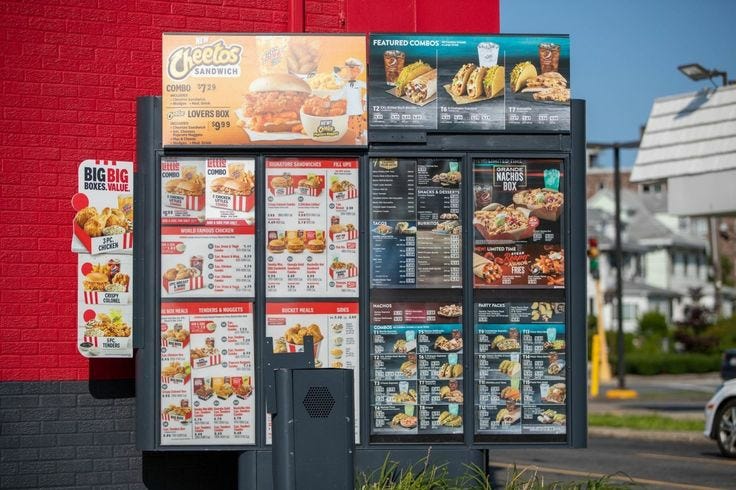
Somehow KFC and Taco Bell have managed a more workable solution
The core issue is that voting systems focused on political parties often have a hard time functioning in a non-partisan context. It also means that a range of popular voting models, like mixed-member proportional and mixed-member majoritarian don’t adapt well either because a key component of these approaches is a party list.
Transferrable voting and budgeting
Transferrable votes have a lot of features which work well in a multi-winner budgeting context, in particular their use in producing a result which approximates an efficient allocation. The single-transferrable vote is a method that has been used in elections and produces proportionate results without party lists, which is a good starting point for budgetary elections. This type of voting works with a ranked ballot, in which all the options are ranked in order from highest to lowest preference.
We’ve also been able to adapt this to a range vote, which is like a 0-5 star rating in a website, with proportional results as well. You can try either over at Groupthink Lab’s Polls site. The greedy alternative vote, which is the standard for most participatory budgeting processes, is like a special case of a range vote (the options are 0 and 1 with nothing in-between) that uses a single-non-transferrable-vote style calculation.
Fast food chains figured out decades ago that when you're selling combos instead of single items, you need a mechanism that can handle bundles without pretending every option costs the same to produce. Voting systems built for electing people need adaptation to catch up to that insight.
sean, the greedy PB critique lands, but the mechanism is wrong. greedy approval PB isn't doing an SNTV-style calculation in any way that matters. SNTV's strategic weirdness comes entirely from the one-vote-per-voter constraint: parties have to guess their support, run exactly the right number of candidates, and get their supporters to split evenly. approval ballots have no such constraint, so none of those incentives transfer. what actually breaks greedy PB is majoritarian sweep. a cohesive 51% approving the same items takes the whole budget. that's the counting rule. the ballot has nothing to do with it.
and you circle the fix for two sections without naming it. your greedy vs cost-conscious distinction is groping toward ballot reweighting, which thiele worked out in 1895: approval ballots, and every time a voter gets one of their picks their ballot weight drops. sweden ran it from 1907 to 1921. the score generalization is reweighted range voting (range voting has been renamed score voting since about 2008), weight = K/(K + SUM/MAX). the oscars use it to pick the best visual effects nominees. and the K knob answers your SNTV anxiety directly, because it just is a divisor method: K=1 reproduces d'hondt and rewards merging, K=½ reproduces sainte-lagué and the merge incentive goes to roughly zero, maybe slightly negative. the strategic pathology you're worried about is a design parameter. radically simpler than STV -- rangevoting.net/RRV
that family assumes equal-cost seats though, so for budgets proper the descendant is the method of equal shares. hand every voter 1/n of the budget, split each funded project's cost among its supporters, take the lowest marginal cost per utility. arbitrary costs are native to it, not bolted on. wieliczka, poland ran it in april 2023, 6,586 voters, one million złoty (~€220k). share of voters who got none of the projects they backed: 18% under equal shares, 28% under the standard highest-count-until-the-money-runs-out method. it also kept the south half of the municipality from getting shut out entirely. aarau, winterthur, assen and świecie have run it since. your 51% red / 49% blue case is the motivating example in the paper.
on approval being inappropriate applied in a single-winner way: a budget package is a single winner. you don't hold a separate referendum on bananas, you pick a cart. approval is the specific reason that can work, since FPTP can't carry more than two or three carts before near-identical ones split each other, which is why real budget referenda are take-it-or-leave-it. voting item by item can assemble a budget that no majority endorses.
the combo meal closer is good. it's just an argument for packages.