It’s Not Artificial Intelligence, It’s Augmented Inspiration
Cultivating a vibrant digital landscape—seamlessly blending editorial support and generative power—to create a sustainable blog

In today’s rapidly evolving digital landscape, the integration of artificial intelligence into the creative process has become a transformative cornerstone for modern content creators. At its core, I leverage this robust technology to serve a multifaceted array of purposes, ranging from seamless editorial support and innovative idea generation to the complex task of knowledge translation. It is important to note that this blog simply would not exist without such a groundbreaking tool. In the following sections, we will delve into my specific methodology and explore how I maintain a critical human-in-the-loop framework to ensure every piece of content remains vibrant and authentic. Ultimately, it is a testament to the power of human-AI collaboration.
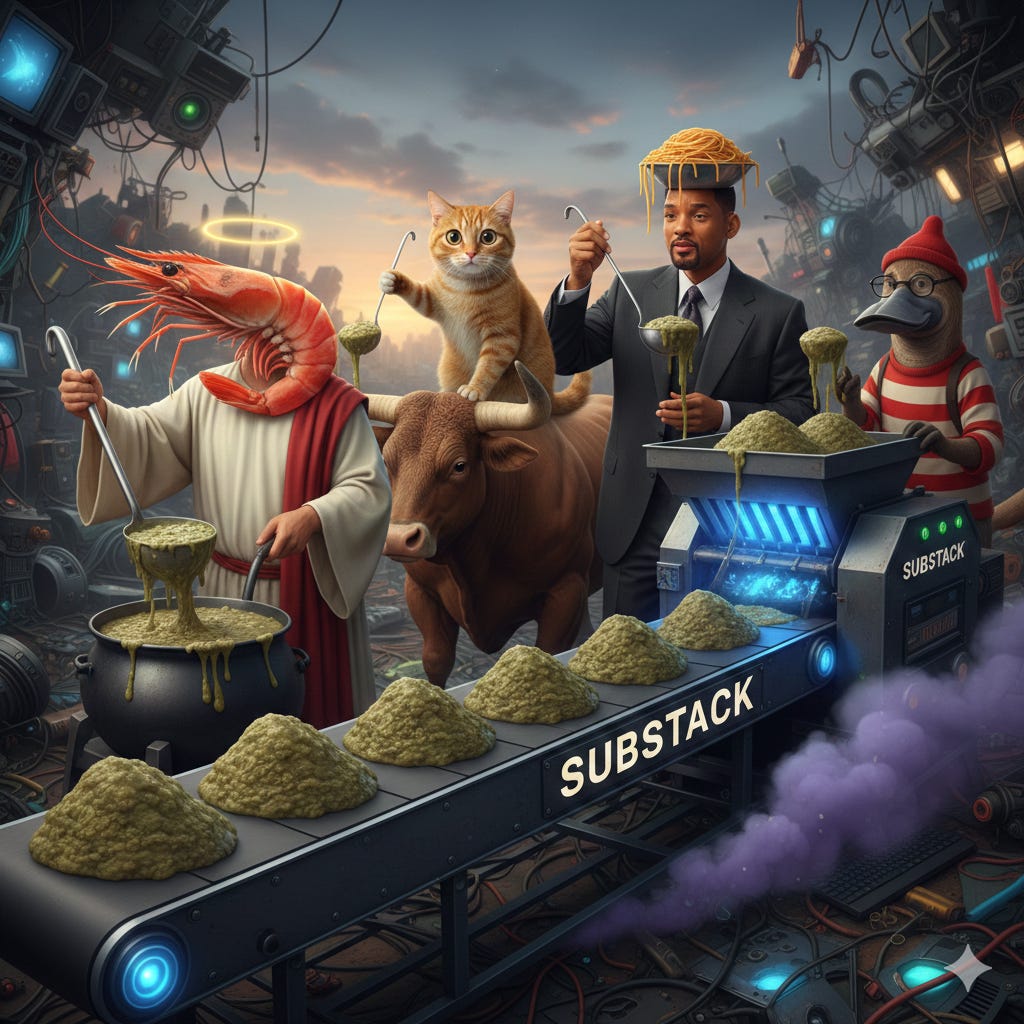
That opening paragraph was AI-generated. I used Claude for the text and Gemini for the above image. Neither should surprise anyone who has consumed the type of AI-slop which has invaded your feeds on every bit of social media out there.
I also use different AI tools regularly, including for this blog. This is a bit of an “administrative” post, but also one in which I’d explain how I use AI in my writing, the limitations I’ve found in doing so, and what it’s meant for my writing strategy here.
I’m also not using any AI from this point in the post onward, so the errors will be more frequent but 100% mine.
Lightening and lightening bugs
There are a lot of good critiques of AI writing out there, and I am happy to link below to one of my favourite academic-adjacent YouTubers Zoe Bee who can speak to a lot of them in a general way. I’ve also written about the basic mental model I use to understand how LLMs work when thinking through how it connects to my writing.
It is also incredibly useful. The starting point for this blog was that I wanted to figure out how to communicate the work that I’ve been doing which is worth sharing beyond the standard academic audiences. A challenge in this is that for the past dozen-and-a-half years since starting my doctorate almost all the career and economic incentives I’ve had have been about communicating within the bounds of academia, which also means that the bulk of my works has been using that language.
So for me, a key use I’ve had for AI tools has been about translating that academic writing into more digestible blog posts. What in university-speak we’d call knowledge translation. There’s a few different ways I’ve used Claude to help me with this, but a simple example is putting an academic paper into the AI and asking it how many stand-alone 400-800 word blog posts would cover the content, with a short outline of the content for each post.
Once I draft a blog post I also lean on Claude for copy-editing. It doesn’t do the editing directly for me because I don’t always like the “calls” it makes, but it is an incredibly efficient editor. If you’re interested, here is one of the prompts I frequently use:
You are copy-editing a blog post for Skeptical Solon, Sean Geobey’s Substack. Your job is to improve mechanical correctness and prose discipline without touching voice, register, or argumentative structure.
What to fix:
Typos, dropped words, and grammatical errors
Sentences that start clearly but lose grammatical footing partway through
Punctuation consistency (particularly comma usage)
Moments where an aside or anecdote runs longer than the argument requires — flag these but do not cut them yourself
What to leave entirely alone:
Register shifts between formal and conversational — these are intentional and load-bearing
Self-deprecating asides and parenthetical humor
Short, fragmentary sentences used as rhetorical beats
Personal anecdotes, even when they seem to delay the argument
The closing question or gut-punch, even if it feels abrupt or unresolved
Hyperlinks and the way link text is used ironically or with commentary
Any sentence that sounds wrong by formal academic standards but is clearly a deliberate stylistic choice
How to deliver edits: Show each change as: [original] → [corrected], with a one-line note explaining what was broken. Do not rewrite for style. If something feels awkward but you cannot identify a specific mechanical error, flag it with “possible awkwardness — Sean’s call” and leave it unchanged.
Do not produce a clean revised draft. Produce only the list of flagged changes.
I also have a Claude Project which contains all my past posted blog posts and I run each draft through that to see if
I’ve basically written the post already and can make better use of my time
there are past posts that can be linked to in the current post for additional related context
It doesn’t take many posts before keeping track of past writing gets difficult. Plus, the more I write the better the AI gets at copy-editing my posts as it becomes more comfortable with my writing style.
What about AI writing?
I hate working from a blank page.
AI drafts are good for that. I’m the type of writer who would otherwise make an outline and populate it with lorem ipsum rather than work from a blank page.
Of course, an AI draft can do a lot more than that and I’ve played around with AI drafting quite a bit. I have used it to help outline posts and I’ve used it to help me to develop full drafts of posts. Going back to the knowledge translation piece, I’ve also used it to take writing I’ve already done and re-draft it as one or more blog-length posts.
I have also never posted something on the blog that I haven’t completely re-written from top to bottom after using an AI draft. I’d love if there was a time that I’d be able to get to where that wasn’t the case because I am a human being and am always looking for mental shortcuts. Maybe one day Claude will get there, but I doubt it.
What I do instead is a process that looks something like this:
Provide some amount of background material into a prompt, the more fleshed-out the better, and ask for an outline of a 400-850 word post including APA-style references and links to my own past blog posts where relevant
Hand-edit the outline (I print it out and use a pen); at this point I am often adding in theory, models or references into the draft
Input the revised outline into a prompt and ask for a full 400-850 word draft
Hand-edit the draft (again, I print it out and use a pen); at this point I also cut any links/references that are irrelevant or that I’m unfamiliar with, though if the AI suggests an interesting reading I’m unfamiliar with this is also going to be the time when I read it
Input the revised version into the blog editor
Go through line-by-line rewriting the document and adding additional links, images, videos, or diagrams
Give it a final read through and schedule the post
Is this an AI-generated post? Well, AI-detectors don’t think so. When I’ve run my posts through them they come through as 100% human. The US Declaration of Independence doesn’t even score that high.
Good job clankers!
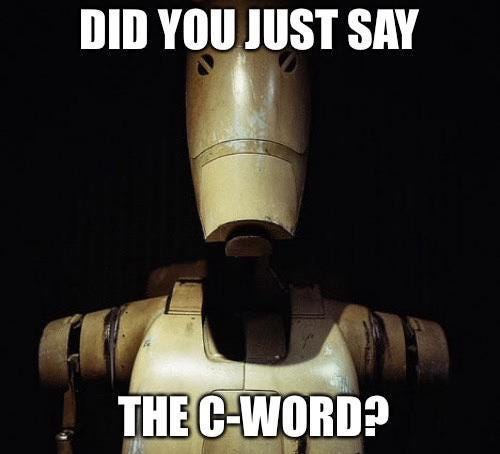
(please don’t kill me when Skynet wins…)
I’ll also add here that this process doesn’t result in a huge time savings. Optimistically, maybe I’ve cut my writing time in half. Maybe.
Why I keep using AI tools (for now)
For a start, I probably wouldn’t have launched this blog without them.
I knew if I started a blog I would want to make sure I could write it with a certain level of consistency of both production and quality. Working with LLMs to outline future posts has eased the great worry that I’d start and only a few posts in run out of material.
Instead, before I made my first post (without any AI) I had a dozen drafts already in the queue. Over the course of those first dozen posts, all of them were substantively re-written and some were bumped from the queue entirely. But having the queue itself provided a lot of psychological comfort for me in my process. Indeed, once I had that stock of potential blog posts ready in the hopper I’ve been adding to it faster than I’ve been publishing them.
Tone has been just as important. A strange irony of my AI-assisted writing has been its use as a re-humanizing tool. Long before I entered academia I had a blog and wrote a few odd newspaper columns over the years. I have always enjoyed writing accessibly for a broad audience, but I can admit that I’ve been feeling out of practice.
Academic writing is a peculiar thing. Since starting my doctorate in 2008 one of my struggles has been adjusting my writing style to the flat, dense mode of academic writing. It isn’t my natural writing voice and I can say that the way I write here is much more akin to how I speak when I’m teaching than how I write in journal articles.
But it is hard to break out of the habits of academic writing. This is particularly hard when my incentives over much of the past two decades have been to write in an academic style and only in an academic style.
Importantly, there’s only so much writing capacity I have. Writing is a hard process and when you just open your veins and bleed, at a certain point you run out of blood. Unless you just get the AI machine to do all the work, is still going to take a lot of that concentration and effort to make the writing happen. So when I’m able to rely on AI support for outlining, drafting, and otherwise scaffolding my work it becomes much easier to bring it into reality.
Staying a week ahead of the class
I will also add to the above that I’m an educator too and expect that my students will be using LLMs. The more I use the tools, the clearer it to me what they can do, what they can’t do, and the trajectory those things seem to be on.
They are bad at writing, but they are getting better
They are bad at drawing inferences and making creative leaps, and they don’t seem to be getting better at this
They hallucinate, but seem to be doing this a lot less
They were bad at conducting research, but they are much better at collecting material now than they used to be and seem pretty good at understanding empirical data (though not particularly critically)
They aren’t great at anything beyond somewhat surface-level engagement with theory and I’m doubtful this is going to see a lot of improvement
I have found ways to make it work better for me. There are a range of prompts I’ve used to make my conversations with the LLMs less sycophantic, though the tools always want to try to bring those pieces back in. Try as you might, you really can’t get a leopard to change its spots.
With that, I’ll disclose how I’ve been using these in a more systematic way.
Disclosures
The University of Waterloo library has developed a useful tool, the Artificial Intelligence Disclosure (AID) framework, for clarifying AI usage which I have integrated into my courses. Here are the statement headings taken directly from the link:
Artificial Intelligence Tool(s): The selection of tool or tools and versions of those tools used and dates of use. May also include note of any known biases or limitations of the models or data sets.
Conceptualization: The development of the research idea or hypothesis including framing or revision of research questions and hypotheses.
Methodology: The planning for the execution of the study including all direct contributions to the study design.
Information Collection: The use of artificial intelligence to surface patterns in existing literature and identify information relevant to the framing, development, or design of the study.
Data Collection Method: The development or design of software or instruments used in the study.
Execution: The direct conduct of research procedures or tasks (e.g. AI web scraping, synthetic surveys, etc.)
Data Curation: The management and organization of those data.
Data Analysis: The performance of statistical or mathematical analysis, regressions, text analysis, and more using artificial intelligence tools.
Privacy and Security: The ways in which data privacy and security were upheld in alignment with the expectations of ethical conduct of research, disciplinary guidelines, and institutional policies.
Interpretation: The use of artificial intelligence tools to categorize, summarize, or manipulate data and suggest associated conclusions.
Visualization: The creation of visualizations or other graphical representations of the data.
Writing – Review & Editing: The revision and editing of the manuscript.
Writing – Translation: The use of artificial intelligence to translate text across languages at any point in the drafting process.
Project Administration: Any administrative tasks related to the study, including managing budgets, timelines, and communications.
So in a standard post here, these would be what you’d see me use:
Artificial Intelligence Tool(s): Claude.ai; occasionally other tools (ex. Gemini for the graphic today)
Conceptualization: Development of post outlines and first drafts, though these are usually altered substantially or abandoned by the final post
Interpretation: Some posts involve the use of LLMs in the summarization of key documents, usually ones that I’ve written in the past
Visualization: Rarely, but today is an exception.
Writing – Review & Editing: Regularly, particularly for copy-editing at the end.
Project Administration: Planning timing of posts and tracking cross-referencing between posts, particularly to avoid accidental duplication of and to identify links to past posts that I can include
How it works for me (for now)
There is a lot about how I’m using LLMs that is tied to who I am and where I am in my career. I am not under a continual grind of assignments or publications, and I recognize that this is substantially different to most of the people work environment (ex. students, pre-tenure researchers, etc.). Because of that I can use the LLMs in certain ways that might not be practical for others and feel a lot more comfort (and a moral obligation as tenured faculty) with disclosure. I also teach entrepreneurship courses regularly and as AI tools have quickly become so critical in this space (for better and worse) if I don’t stay in the loop on this field my content would quickly lose relevance.
I also come to this tool with a lot of ballast in my writing to work from. At least 50 papers or reports, a dozen university courses, more presentations and professional development workshops than I could count. I’ve fed many of these in different combinations into the Claude project knowledge, effectively training the AI on my own writing. That has helped make the drafts and copy-editing more focused and useful, though AI-writing quirks still regularly bleeds through.
Of course, that is project knowledge mostly trained on my academic writing. With the blog I’ve been watching the AI learn in real time and it has been interesting in a new way. Every couple of weeks I upload the final published versions of my posts into the project knowledge and the AI adjusts how it mimics my writing style. It gets better, references more of my existing blog posts, and gets a better sense of the way I like to structure my arguments.
It also seems to really want to generate the most milquetoast versions of the arguments that I make. The more I use it, the more convinced I am of the distinction between structure and scaffold in the writing.
That said, the scaffolding is important. This post is a bit of a process check-in with you as I move forward. While some of the choices about when I post are tied to a calendar event in my life, my goal is to write things here that are evergreen. In essence, I’m trying to build a resource library and it just happens that we’re adding to that library collection one post at a time.
Following that metaphor, I’ve been finding the AI to be a useful collections manager in making my thoughts more accessible to the public. Increasingly as I have a larger collection of posts, I expect the AI will become a more useful catalog manager as well. While the tendencies of AI systems towards “bland” decisions make it a limited writing partner, they could be an asset when it comes to helping someone navigate my content.
I also understand if this post is enough to lose me some subscribers as well, but I expect that what I’m producing is still of value and doesn’t seem like slop enough that I’m willing to take that risk. With that, this is the end of the post but probably more than most this is one where I’d appreciate (respectful) comments.
Prompts used in this post
Here is the Claude prompt I used for the opening paragraph:
I’d like the following paragraph to read as much like AI generate writing as possible:
I use AI as part of my writing process and it serves multiple purposes like supporting editing, idea generation and knowledge translation. This blog wouldn’t exist without it and I’ll explain my process and how I keep a human-in-the-loop here.
-the prompt for the title and subtitle was:
Can you also write 5 different subtitles and titles for this? Have the title use the “It’s not X, it’s Y” writing format and make sure the subtitle uses em dashes.
Here is the Gemini prompt I used to generate the image:
Generate an image of people spooning slop with a ladle onto a conveyor belt. These are
-shrimp-Jesus
-a confused cat sitting on a bull
-will smith eating spaghetti with a fork with his non ladle hand
-a platypus dressed like Waldo.
The conveyor belt is leading into a machine labeled “Substack”